The room, and how to visit it
The auditorium and your visit
The horseshoe auditorium of Budapest's Opera House, its fresco and chandelier, plus how to get there, rehearsal days, photos, access and what to wear.
Reserve the Opera House tour ↗Quick answer
Yes, the auditorium is the high point of a visit: a horseshoe of red and gold boxes under Károly Lotz's painted ceiling and a bronze chandelier. Reach the Opera House at Andrássy út 22 by the M1 metro to Opera station. Rehearsals can close the auditorium to visitors, in which case the tour continues through other parts of the house, so treat the room as a bonus, not a guarantee.
The room in red and gold
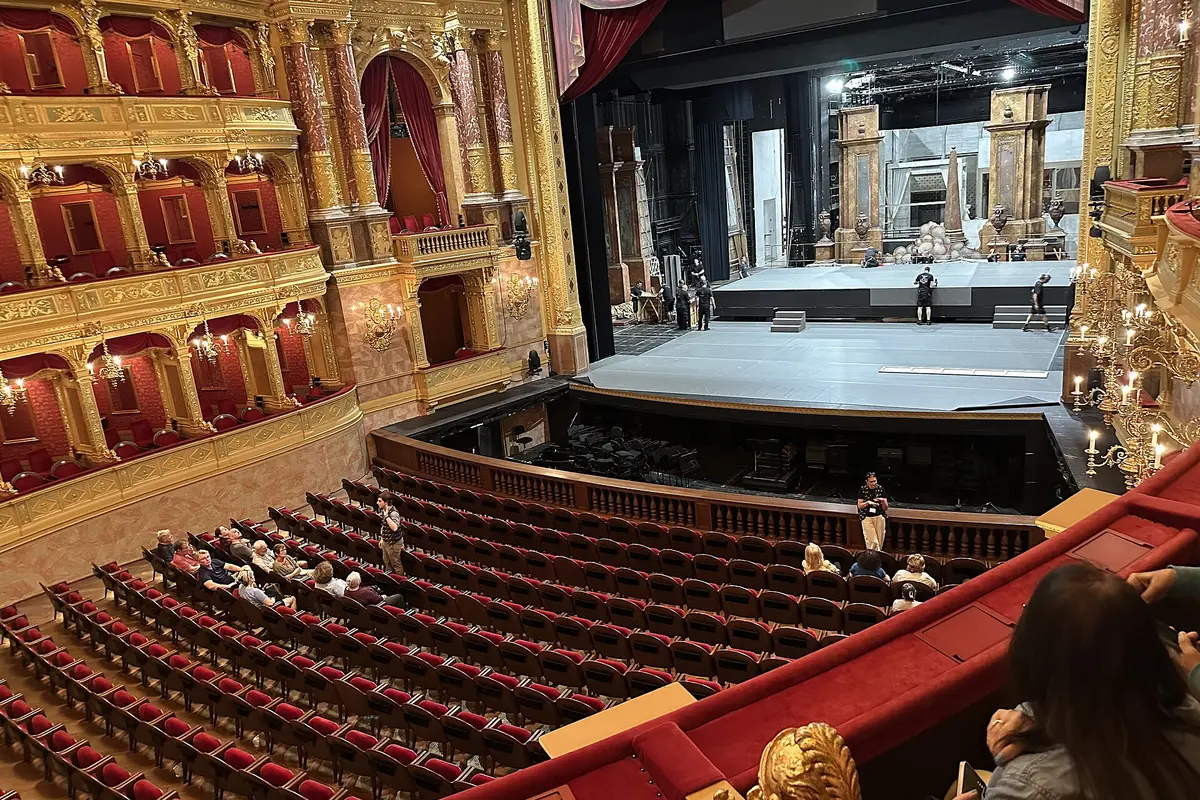
The opera's own description calls the horseshoe-shaped, three-storey auditorium an exhilarating feeling of space, with a calm, harmonious composition in red and gold. Each storey curves differently, with each higher level receding behind the one below, yet the overall sight is unified. Miklós Ybl set the decorative system himself, with an eye on graduation and rhythm. The gilded parapets use twenty-four-carat gold. Boxes were once a measure of wealth, and the opera notes that the audience in them are practically part of the performance.
The ceiling fresco
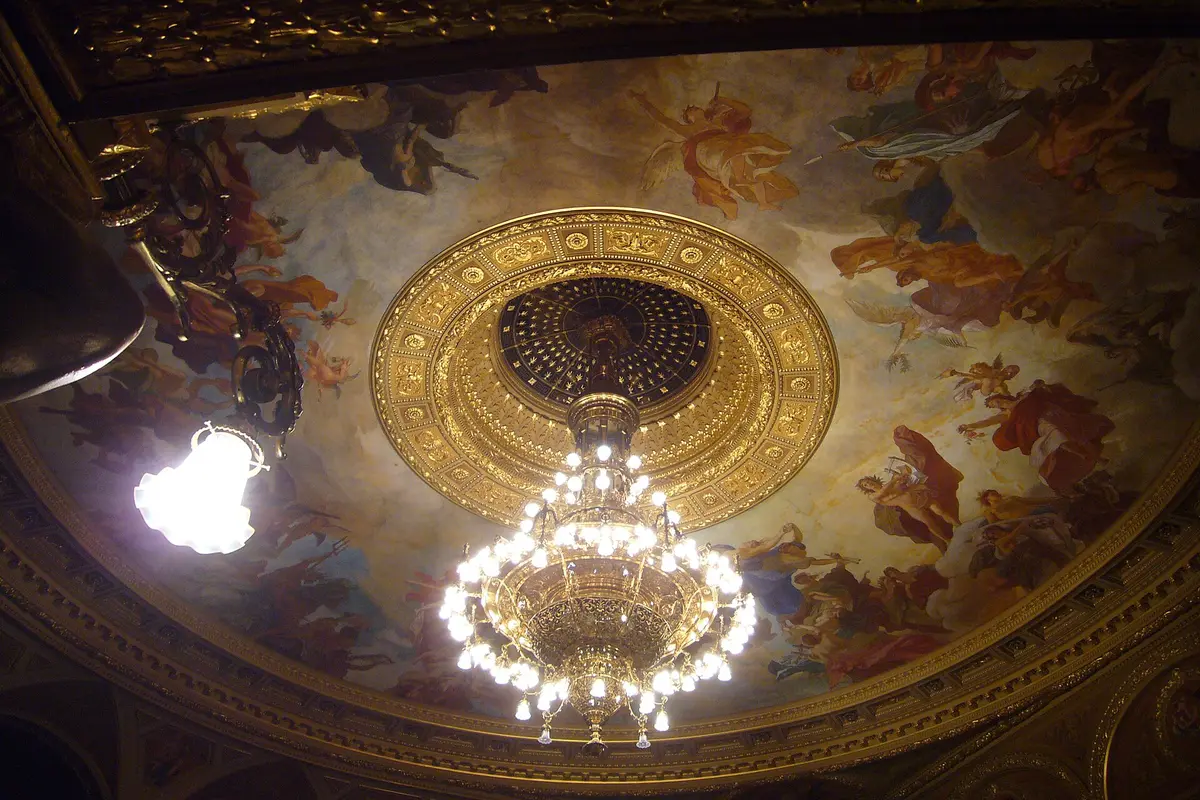
Károly Lotz painted the circular ceiling fresco, called The Apotheosis of Music. It shows Mount Olympus, where six groups of gods listen to Apollo. Among the figures the opera names are Zeus, Hera, Nike, Pallas Athena, Hermes, Poseidon and Aphrodite, along with muses and the protectors of nature and morals. Its light colours owe a good deal to the marble powder plaster used for the ground, which brings out the blue of the sky and the gold of the clouds. Lotz painted all of the paintings in the auditorium.
The chandelier
The chandelier was ordered from Mainz and installed in 1884. The opera says it is still lowered to the stalls by manual winches twice a year, for cleaning and to replace burnt-out bulbs. It originally weighed three tonnes and carried five hundred gas lights. Electric wiring was added in 1895, and the gas pipes were removed in the 1980 renovation. Today it weighs about two tonnes and has more than two hundred bulbs. When they dim, the opera says, the performance is about to begin.
The boxes and the royal box
The royal box sits in the middle of the grand circle and is reserved for Hungary's three most important heads of state and their guests, though the opera notes that real royalty has watched from it too. Four neighbouring boxes hold Gyula Donáth's statues of the tenor, soprano, alto and bass, and four more statues of prudence, courage, temperance and justice close the horseshoe. A legend says Queen Sissi preferred a proscenium box, which she could reach by the royal stairs without meeting anyone. Another says a putto orchestra painted on the arches plays excerpts of the day's performance each midnight, a tale the opera itself calls a fairy tale. Many regulars still book the same box year after year.
Rebuilt for the 21st century
The house reopened with a gala on 12 March 2022 after a refurbishment lasting nearly five years. The opera says the work brought back the original colours and materials, rebuilt the stage machinery and improved the acoustics. The stalls were rearranged in one horseshoe-shaped block, the rows are further apart and the seats larger, and there are now four seats in each box instead of six. As a result the capacity fell from 1,200 to about 1,000. The stage machinery is now computerised and, the opera says, will be absolutely silent. Audio narration and an induction loop were added for visitors who need them.
When the auditorium is closed
The opera says the auditorium is closed to visits during rehearsals, and then the route takes visitors to special, previously unseen areas of the house. Guided tours are not available during performances. The booked tour's page adds that the opera may cancel tours during rehearsals and offers an alternative date, and that the light in the auditorium is reduced on some occasions. The season runs from September to the end of June, so check your date against the programme when you plan.
Read next: Rehearsal days, reduced light and busy rooms
Seeing the room at a performance
A show lets you sit in the room instead of looking at it. The opera says its boxes have been sold as a unit since 2022, so you cannot buy a single seat in one. English and Hungarian surtitles appear above the stage, and the opera adds that subtitles also show on small screens in the seat backs and armrests in some rows. A limited number of low-priced standing tickets go on sale shortly before curtain-up, with a restricted view. On a tour, the chandelier Ybl envisaged lights the fresco, and the opera says that light enhances the beauty of the painting.
Getting there
The Opera House is at Andrássy út 22. The opera's visitor page says the M1 metro line stops at Opera station, and that city buses and trolleybuses also stop on Andrássy út outside. Street parking is possible nearby, but spaces are limited and a fee is charged on weekdays. The meeting point of the booked tour is inside the building, in the hall, and the opera's own tour starts at the information desk in the entrance hall. Andrássy Avenue was added to the UNESCO listing for Budapest in 2002.
Languages, children and photos
The booked tour has live guides in English, German, Italian and Spanish. The opera's own tours run daily in English, with other languages on request, and children under 3 go free on them. Photography for non-commercial purposes is allowed on the opera's own tours, but flash and tripods are not. For performances, English and Hungarian surtitles appear above the stage. Check the booking page for the age rules and any photo rules that apply to the tour you choose.
Access, dress and cloakroom
The booked tour is listed as not suitable for wheelchair users, so if step-free access matters, ask the opera before you book. For performances, the opera says a lift on the left serves the stalls, an accessible box and accessible toilets. There is no official dress code, though many guests dress elegantly out of respect for the theatre. At performances, coats and bulky bags must be left in the free cloakroom, so travel light on show nights.
Who this isn't for
If you can only visit on a day with a performance, the guided tour will not run, so choose another date or buy a ticket for the show instead. If step-free access is a must, check with the opera first. Otherwise this is an easy, rewarding hour for first-time visitors, families and anyone who enjoys ornate interiors. It is among the most photogenic rooms in the city, and if you would like to sit in it for a whole evening, the opera sells tickets to its own performances.
Frequently asked questions
How many people does the auditorium hold?
About 1,000 since the 2022 modernisation, according to the opera, down from 1,200. Older sources give 1,261, from before the rebuild. The stalls were rearranged, the rows set further apart and the seats made larger, which reduced the number.
Will I see the auditorium on the tour?
Usually, yes. The opera says the auditorium is closed to visits during rehearsals, though, and the tour then goes to other special areas. The booked tour may be cancelled during rehearsals, with an alternative date offered.
How do I get to the Opera House?
The M1 metro stops at Opera, and buses and trolleybuses also stop on Andrássy út. The address is Andrássy út 22. The booked tour meets inside the building, in the hall, and the opera's own tour meets at the information desk in the entrance hall.
Is there a dress code?
The opera has no official dress code. Many guests dress elegantly for performances out of respect for the theatre and other guests, and the opera does not require it. Neat everyday clothes are a sensible choice for a daytime tour.
Can I take photos inside?
On the opera's own tours, non-commercial photography is allowed, but flash and tripods are not. Rules can differ on a booked tour and on performance days, so ask your guide before you start.
Can wheelchair users join the tour?
The booked tour is listed as not suitable for wheelchair users. The opera has lifts for performances and accessible boxes, so contact the opera about the best option for you.
Sources